Paradox From Within – Altruism

By Renee Shay, Harvesting Thought

explore

During my school age years there was no doubt in anyone’s mind that I was a hot mess.  I had a teacher once tell me who had been trying her best to help me that it appeared to her that other people loved me more than I loved myself.  How many things we hear, how many things we forget over a lifetime and that is one impression of me from someone else that has stuck with me thirty-seven years later?  She had told me that if I do not reconcile that then, it will not go away, and it may prevent me from achieving fulfillment in life.  You could say that low self-worth has been my constant companion, and she could very well have been right but not in the way one might think. 

It does seem strange to me that for someone who sees value in everything, for someone that feels bad for killing a spider, that I would struggle to love myself.  I can cry at the drop of a hat during some sappy movie, upon hearing the star-spangled banner or witnessing the fallibility of an elderly person.  I had once given a gray-haired, small in stature, elderly woman who had been sitting in a doctor’s office waiting area, minding her own business, forty dollars and told her to have a nice Thanksgiving.  She replied, “thank you.”  Probably had more money than I at the time but was so generous to just accept it, she was beautiful.  She did not push it away and say she was not deserving of the kind gesture.  That was the same year my mother had passed so it would have been the first holiday season without her. 

In that moment, as another example of too many to tell right now, I had been called to act and the only thing I could give, was the cash from my pocket as an exchange for a stranger touching my heart because she reminded me of my mother.  I am sure she went back home and had a good laugh with her family about this stranger that handed her some money for no good reason.  I can demonstrate a deep and sincere compassion for others, even an elderly stranger who just happened to look like my mother, but what about myself?  Why has it been so hard for me to do, to be kind to me?  I have improved my self-worth over time, but have I done it with the grace and dignity I can show a stranger? 

Could the answer to those questions lay on the other side of me, the paradox within me?  The critical side who is always striving for perfection though knows perfection is an illusion.  The judging side that can easily see the wrong in others therefore must feel herself to be wrong too.  The harsh and mean side of me that ridicules others, which puts others down to build herself up, that side? 

The bullied who becomes the bully, everything is a paradox.  The tough side in me that must stand up to every bully whether it is for self or fighting for somebody else?  The self, contradicting itself or is it a natural state of being, the yin-yang of our existence?   While I know having two sides seems simple, it is not.  While night and day, black and white, life and death, seem like simplistic and natural opposing forces, they are not.  It is all the gray that exists between any two states of being within anything, even the paradox from within, which can be complicated and destructive.

challenge

The challenge then becomes to better understand oneself and reconcile the price to be paid for having extreme “gray” between all the good and bad that can hurt self, hurt family, hurt friendships, and even hurt strangers just as much as it can love all these things?  How does one continue to develop the better side, the loving side, the non-destructive and compassionate side of their self?  When does the need to win subside and become the need to win for more than just yourself?  How do you decide when to risk, whether it be reaching back to reconcile or reaching forward to something unknown and new? 

Another question might be, do I need to?  Having left a trail of broken friendships, a trail of broken trust, a tsunami of things that went wrong still haunting me in a shadowy corner of my mind from all that is past.  What a weight to carry all this time.  What a burden to think you alone, you alone, were responsible for it all.  What if you did not carry the hurt and only decided to carry the good?  Of course, there was a lot of good.  You do not get to friendship with someone without some good times, it was not all bad.  Of course, most friendships do not end because it is all good, something goes wrong, but that does not mean you cast aside all that was good.  It is natural for someone who hates oneself to carry the bad, to internalize the bad and to think they are unworthy, unlovable?  How arrogant to think that we alone are the only creatures with regret.  Ego, so powerful, so destructive.

Do we as humans withhold love from others out of fear of rejection?  What if that stranger sitting in the doctor’s office rejected my offer of the forty dollars?  How would I have felt as in that moment I attached deep emotion that welled up inside of me, the love of my mother, enough of it to take a risk, reach out to a stranger and give her something?  In the moment, I was thinking past the forty dollars, thinking that one could buy a nice Thanksgiving dinner for that amount, that one could enjoy a nice meal for that amount.  I was projecting beyond the eyes of a stranger and into her world, her needs, as if she were my own mother who would be alone for the holiday.  There was a human-to-human connection in that moment that if the woman responded in any other way like, “get the f out of here, I don’t need your money,” rather than, “thank you,” wow, how would that have felt? 

-expand

Risk.  Stepping out of oneself, one’s comfort zone.  Even when we can create a cloak of protection over oneself for an entire lifetime, shielding ourselves from hurt and loss, even then not wanting to risk.  Or just could it be the exact opposite of what you think it is.  Could it be that you are such a perfectionist, think so highly of yourself that your Ego tells you if you are not perfect, you should avoid a situation for fear of being seen as imperfect?  That it does not come down to not giving yourself enough worth but that you give yourself too much.  That you take on too much of the responsibility to either be perfect, to be the best at something or be nothing at all.  That you believe you alone are the one that is responsible for how a friendship goes or does not go.  While yes, you are responsible for your behavior, your actions that can led to someone’s trust or distrust, you own that, but you alone are not responsible for everything, the other person and their behaviors, their actions.

Full circle, the yin-yang of it all.  A spider, a movie, the star-spangled banner song, an elderly woman, what do all these things have in common?  Things I mentioned in my second paragraph of this blog as samples of things that can draw emotional reactions from me, eliciting empathy for things outside of myself.  Why?  My ego does not have any direct relationship to any of these things.  Why would emotion factor into killing a spider, watching a sappy movie, hearing the star-spangled banner, or observing an elderly woman sit on a bench in a doctor’s office?  The spider was deadly, and I was protecting myself, the movie was made to illicit my emotion, the song sung to dig into my patriotic bones, the old lady wasn’t even sick, wasn’t even lonely, she could have been waiting for her son, the doctor?  I project things onto all these things though I do not truly know any of them.  How much could I project my self-worth onto things throughout my own life that have nothing to do with me?

How could it be that others love me more than I love myself?  Could it be for the very reason I feel empathy toward a stranger?  Are they reacting to me for some reason that does not technically have anything to do with me?  Isn’t that what I do?  It says more about the one who loves than the one who is loved.  That is, it.  We are all on this bazaar journey through life for over a couple million years and still do not understand the essence of ourselves, of our ego.  Others do not really love something outside their selves any more than they love themselves.  They are projecting their love for other things to unconsciously fill a need that exists within them just as I have been doing all my life.  Even those who we believe to be the truest of the altruists in life are not necessarily sacrificing for others, they are sacrificing for themselves.  The paradox from within in its purest sense is altruism.

Now I Lay Me

By Renee Shay, Harvesting Thought

explore

“Now I lay me down to sleep, praise the Lord, my soul to keep.  If I die before I wake, God my soul is free to take.”  What a hell of a thing to teach a child, this prayer, so that they say it every night before they try to close their eyes to sleep?  I was taught this prayer.  Going to bed every night that I can remember from my childhood, thinking about the fact that I might not wake up.  I used to also hate sleeping on my back because not only was I already thinking about death as I recited this prayer, as I got older, going to open casket funerals, you realize that laying on your back, arms across your chest, “sleeping,” is the death position.  Add these two things together, it becomes a perfect recipe for a lifetime of struggling to fall asleep.  I feel the need to explore these types of things and to recognize the impacts they have on one’s life.

I was baptized and raised in an average Catholic household.  My parents made us kids get out of bed, when we had that one chance on the weekend to sleep in and made us go to church every Sunday and on Christmas Eve.  They made us attend catechism and eventually go through the confirmation process.  I remember hating to wait for my parents to pick me up after classes.  It was a fact, my family was the last most every time, we would always be waiting to get picked up.  We would often go back into the dark creepy church, one would go down the stairs to the basement to find the church aid at her desk, we would ask her to use the phone.  The others of us would stand guard upstairs but we were kids and curious.  We would often open the sanctuary doors and peer in.  It was quite different at night, lights off, with no one in the pews.  We loved pushing each other in and getting spooked by the torturous station of cross statues illuminating in the minimal light coming from the stained-glass windows.  I can add that too, thanks to Catholicism, a lifetime of stress built into my psyche for those who are late and the disturbing impression an empty church can leave on a child’s imagination. 

I was confirmed my senior year in high school whatever being “confirmed” meant, it meant nothing to me.  I do remember having to sit with the priest in open confession near the alter, to get confirmed.  Oh boy, the secrets I could have told but did not.  Why would I, to the stranger in a robe?  That was not the type of confession that could cleanse a soul, not even close.  It was clear then as it is now, I did not care about Catholicism and just went through the motions to do as little as possible to get through it.  I did not care about what the strange man in the robe was preaching on Sundays or whispered to me in open or in closed confession while having a screen between us.  As if that hid our identities, laughable.  No way, one truly confesses in that setting, no way.

I did not care about what the nuns or parishioners who volunteered to teach us during catechism were trying to teach us.  No offense to them though, they were oftentimes the mothers of my classmates, meant well, and some good nuns.  I believe, if I recall correctly, even my mother, when she had the time, assisted in helping my class prepare for confirmation.  Truth be told though; I had felt no connection to the church even with her involvement, none.  I felt awkward studying with those I studied with in my public schools.  I hated singing, kneeling, genuflecting, reciting prayers and bowing down to some guy hanging by nails on a cross with red blood drops dripping from his hands and feet.  Again, how disturbing to be worshiping a man that was hung on a cross, in some foreign land, so many moons ago, no one that I have met in my lifetime has ever met.  Blood dripping from his feet and hands?  Seriously, disturbing to say the least.

I did not understand the depths of the hypocrisy that I was witnessing, I was a child, of course I did not.  I did know something was not right, I knew that.  I was smart enough to know to be wary of what I was hearing while someone carefully selected some passage from a book called the Bible, written so many moons ago, you wonder what its relevance is today on my life, turns out, none.  I did know not to trust those who claimed to be religious on Sunday.  I watched them parade their families through the services, it was a show.  I knew some who were looked up to in the community and the church.  They were the lawyers, the doctors, priests, and the business owners, but they were also the drunks I witnessed the other two nights, Friday, and Saturday, of those same weekends.  I knew they were nursing hangovers those Sunday mornings in church and were forcing themselves to attend.  It was not long until I became one of them, hungover and pretending on this one day of out of the week to be a good churchgoing person. 

challenge

This week began with me hearing on a National Public Radio (NPR) – British Broadcasting Corporation (BBC) segment about the stories coming out that 215 children were found in a mass grave at the Kamloops Indian Residential School in British Columbia [BBC News – Reuters Article May 29, 2021].  This one school out of many, was the creation of the Roman Catholic’s quest to assimilate indigenous people into their way of being.  It is just another reminder to me about the hypocrisy that existed and still exists today with people who claim to be religious.  About how the church tried to indoctrinate me.  As if the actual term “religious” has any graceful meaning left to it, not to me.  What atrocities have taken place throughout history at the hands of these humans who think their way is the best way?  What lengths, how many have died at their hands? How many more graves there are yet to be found?

I often think, would my family, some two hundred years ago, have partaken in these types of actions, if those were the times?  Would these types of teachings, would these types of crimes committed at the hand of churchgoers, taking children away from the only life they had known and dumping their bodies in unmarked graves have been so commonplace to think that my own mother could have fell victim to those beliefs then?  How did those Kamloops children die?  At the careless or abusive hands of those teaching them that their way is the way to live?  My mother was never such a person, and I am not meaning to suggest that she would be capable of such horrors inflicted upon innocent child.  She was a beautiful hardworking soul who would not hurt anyone, she saw the lines not be crossed.  Hard to imagine, if this were normal, what would any of our parents have been like then?

Infallible righteous teachings through the millennium that still exist today.  I do know, my own parents had their boundaries.  I do believe in my heart, that even though many others participated in such atrocities that my parents would have not.   They had conviction, they knew right from wrong, even if the priests that preached did not.  Even if the others who stood beside them during Sunday sermons as business owners or churchgoings could very well have been the ones who would have.  I have evidence that my parents had lines they would not cross. I have their stories.

Growing up, my father used to tell us the parental guidance (PG) rated stories about how he was abused by nuns.  Sometimes it was stories we overheard when the grownups were talking, and we were in the other room but could still hear them.  As we got older though, we heard them directly from him.  He would tell of the abuse he endured at the hands of nuns during his Catholic School days.  How, if he were doing something incorrect in the classroom, whether it be grammar or behavior, whether it be someone who was left-handed and they wanted to make right-handed, he or they would get the rule slaps across their hands.  Nuns freely abused kids in the classroom, the rule was the mild form, humiliating those who were abused in front of their peers.  He grew up and vowed to himself that he would never put his children into a Catholic School system, never and he held to that, all seven of us kids, went to public school.

There were other stories like when my parents had to rescue my Aunt Rita, my mother’s sister, from a nunnery that was not allowing her to fully express herself.  She had more progressive views on how things should be but that was not allowed.  She was becoming increasingly distraught with her plight.  She had promised to dedicate her life to the service of that guy hanging on the cross, Jesus Christ, but she could not have her own thoughts, her own way of interpreting her experiences.  It was cult-like, and it was a harrowing experience that my parents went through to get her out.  The nunnery did not want to let her go.  Through the family stories you hear how my parents were credited with saving my aunt from the Catholic church.  You see, my parents were never going to put us in a school system like that.  Though, they did maintain a relationship with the church, though they did put us through baptism, catechism, and confirmation.  They said once we became adults, we could make our own choices about whether we wanted to be connected to the church or not. 

My mother, later in her life, when she had more time, delivered communion to nursing homes and assisted the church during the communion portion of the service.  Still churchgoing, faithful, until her dying breath, with wanting the priest to deliver her last rites, she believed in it.  There was still that hook, some eighty years of life, a hook.  One of the last things she said on her death bed as our oftentimes loud and unruly family gathered around her over the course of two days to say our goodbyes, she said, “I don’t need rest now, I will get plenty where I am going.”  She believed, bless her soul, may she rest in peace.  It is hard to grapple with, my challenge is that I see someone like her with a faith that tells her if she is devoted to it, she will reach the promised land.  Yet, such a beautiful soul as she was, there were others with those same beliefs that were not as beautiful, that committed crimes against children.  What is wrong with this picture, with this thing called religion?

expand

My week ended with the reflection and celebration that the United States of America, the Congress (House 415-14 vote & Senate 100-0) who are filled with those we have elected to govern us, reached consensus that the day of June 19, 1865, will now be a federal holiday.  Most have just thought of Juneteenth, if they thought about it at all, as a black thing, some type of event for black people.  Having no idea of the history, the meaning behind it.  I too admit that over the years, when I saw and went to the celebrations in my own community, I was expanding my knowledge of its significance.  Now, at least once a year, others in America, those with skin as white as mine, will have to at the least recognize that the day exists and that it is an important day in our, both black and white, history.

My week bookended by thinking about religion, thinking about the pain and torture those young souls endured at Kamloops and other religious places like it, in the name of Jesus Christ, and to be thinking about slavery.  The unspeakable, the unfathomable, the incomprehensible treatment of other human beings.  How could any one of these things be done to another human?

I sat on a rock on the shores of Pacific Grove, California yesterday for the first time in our history during a Juneteenth federal holiday.  I was elated yet saddened to know what was behind it all.  I closed my eyes and began to contemplate how it must have felt for someone across the world sitting on a beach on the continent of Africa, many moons ago.  Sitting on a rock on a beach as I am, enjoying the same sounds of waves, enjoying the same warmth of the sun on their face, enjoying the same sounds of sea gulls passing by.  Some other human being with the only difference than me being the color of their skin.  I ponder, I see a sailboat passing by offshore, it goes along its merry way and does not bother me.  And I imagine them seeing a ship drop anchor in their bay, row boats coming ashore filled with strange men with skin whiter than theirs.  I am in no danger, but they were.  They would be taken from their shore, beaten near to death, chained, brought across the world to my shores, never to return to their homeland again, enslaved by the people with skin whiter than theirs.

A lot of terrible things have happened to human beings at the hands of those righteous few who think that it is okay to harm another that they were incapable of seeing in their own likeness.  The two examples here, Kamloops and Slavery, only naming two out of the uncountable many.  How could someone justify unthinkable acts with such destructive consequences on other’s bodies, minds, souls, oftentimes in the name of business, culture, ethnicity, and religion?  

I applaud our Congress this week.  Not the cowardice fourteen congressional white men who were incapable of being true to themselves, not them, but the rest of them.  Not for doing the right thing because many do not have that capacity but for taking an action that will now force others to force themselves to either look away once a year and pretend our history is not our history.  To have them must learn more about a day in our history when they lost the battle to keep slavery alive, the word was out.  To have them to have to recognize that somewhere deep down in the history of these America’s, in history of our own families, our own communities, our own places of worship, we are capable of such atrocity that they should think, those church going, prayer loving selves, “but for the grace of God, there go I,” whenever they hear the word Juneteenth.  

It is my hope that someday humans put the Bible, their version of it, on a shelf where it belongs.  It is a part of history, but it is the past and does not need to be our future.  It is my hope that we use our desire for community to include all of humankind not just a select few.

Connecting With My Herd

By Renee Shay, Harvesting Thought

explore

Nature is my place of worship, never have I felt comfortable in a church or with any sort of manmade religion, including Catholicism, of which I was indoctrinated into as a child.  From the time I can remember, I have always found solace in exploring my outer world, outdoors, while in contemplation of what was happening in my inner world.  Whether it would in my backyard, the woods or by the river, I would seek nature out if I needed a moment of serenity. 

I was recently reminded of this fact when I was on my second drive across our beautiful country, this time by myself.  I believe, only in America, can a woman be safe and not be alone amongst strangers.  I took the northern route again so that I could go through Theodore Roosevelt and Yellowstone national parks, hoping to see bison this time.

As I clipped along 94 West in North Dakota, the freeway was more desolate than normal due to COVID19, I noticed something out of the corner of my eye.  I was elated, the sun was not fully awake yet, so the landscape had just begun to open, and this is what I was seeing!  It was two giants, I do mean giant, bison walking slowly through a field of yellow grasses.  I was on the freeway, this was not an emergency but a necessity to commune with nature, not much traffic to speak of, so I pulled over.  Are you kidding me, day was breaking, you know the quietness of the sunrise and I was standing near a field watching the two bison? 

As I moved through the ditch and closer to the fence, they watched me and me watching them, I noticed they were also looking back on their trail.  With the morning more in focus as the sun rose, I realized that they were moving along, stopping, waiting for the others to catch up too.  Here they came, as slow as could be, six more, much smaller than the first two, but not calves.  The darkness of their hides against the yellow grasses and the blue skies rising with the sun, my day was made.

challenge

I had more time on my hands this second trip back to California after a few days spent moving out of my house, signing the closing paperwork, and done, that chapter closed.  So, I left the freeway again and entered the Roosevelt Park area, deciding to get a pass though the ranger station was not open, in fact, I was the only person around the entrance.  See, my first trip out this past spring with my good friend, we had thought we saw a bison sitting along the freeway near the park, but we never had the time to explore more.  I had to confirm that it was originally a bison and not a rock mirage for my mind’s sake. 

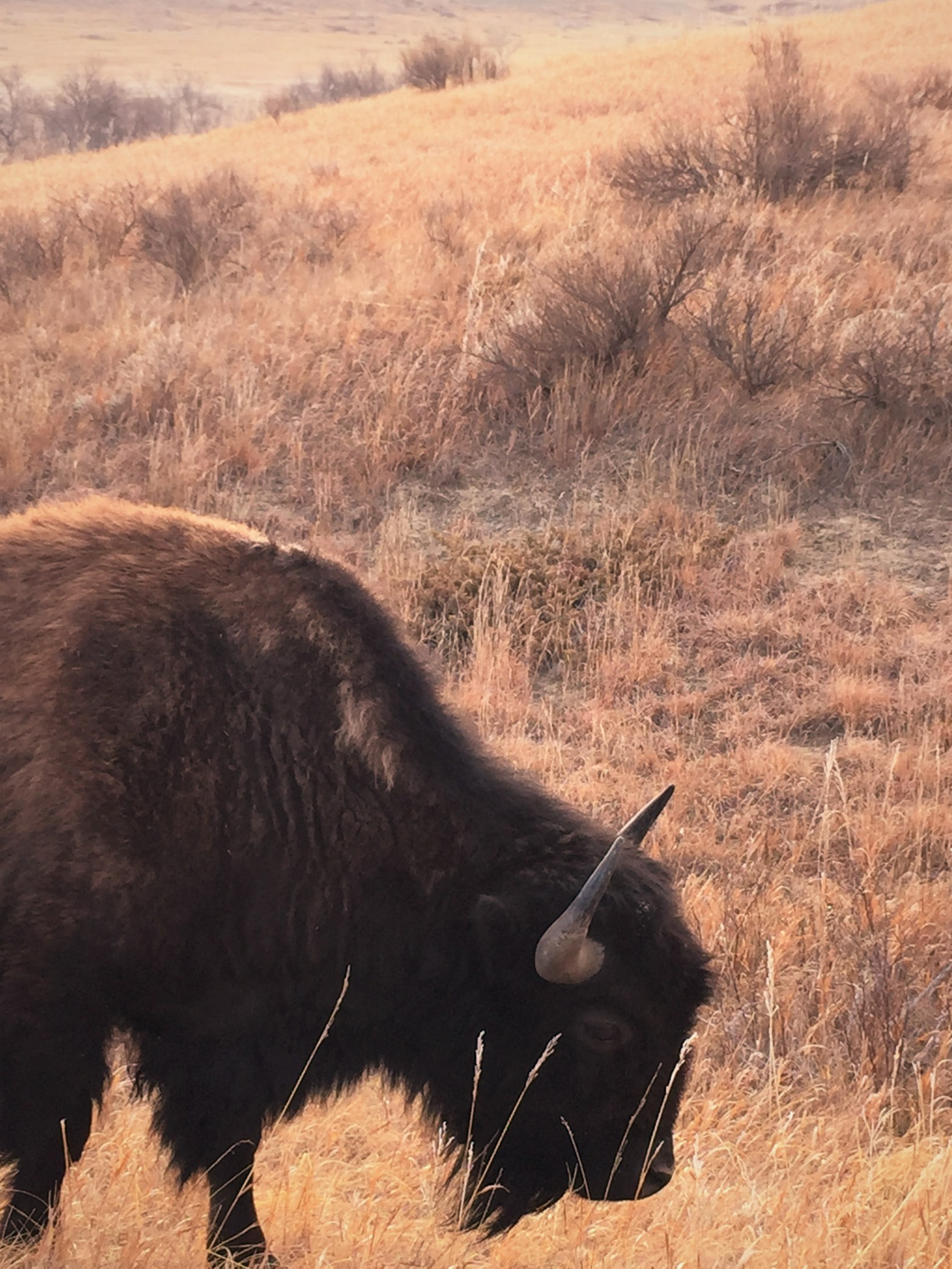
The herd I saw was the beginning of the proof and then confirmed, as I got closer to the park area, there was no rock where we thought we saw the bison before (full disclosure, we pulled off the freeway that time too to take a photo), this was a good sign.  I expanded my search and entered the park.  I crossed over a bridge and immediately came across this bison walking along the roadside.  I was surprised as I just passed a group of surveyors, my first sign of humans in the park.  This bison (photo on this blog) did not seem to care about them or me.  He meandered along with me in my vehicle fifteen feet of him, not bothered by the car running or my photo taking.  Interesting enough to me, I noticed he was not a giant like the others I saw off the freeway, much smaller adult male.  It was curious to me that he was alone, lost or outcast for some reason, I was not sure. 

expand

I let him be after a moment and drove further into the park searching for his herd, he must be a part of one, right?  I did not see many more humans other than the surveyors and few stragglers in cars every now and then.  Some of the roads were still closed due to winter or construction, so I took the ones that were open.  I saw wild turkeys, deer, a couple more solo bison, which was about it.  Quite desolate, I never ran into the herd again that I had seen off the freeway as the sun rose earlier that morning.  They were off in the sage brush or on one of the closed roads or far enough away that I would not be able to catch up with them again. 

I did not find another herd that morning though I did have a spiritual moment with the juxtaposition of what I did see and that was the important thing.  As I expand my own universe by closing one chapter of my life, selling my home in a placed I had lived in for sixteen years, this was a good lesson.  I knew I made the right decision, no second guessing, I was on the right path with this move.  But one question remained for me, where was his herd? 

I re-learned from this experience that some male bison do not have a herd yet.  Because males must compete with other males to determine who will be allowed to breed within a group of females, some are outcast as “bachelors,” in search of their own herds.  Of course, this makes sense, I knew this about herd animals but had to relearn it for a moment.  Sometimes when you see someone who appears alone, that does not mean that they are “lonely,” sometimes it is by design and just what is needed to get to their next chapter in life. 

The Potential of Me

By Renee Shay, Harvesting Thought

-explore

Less than two months ago I wrote a blog called “Selling Short” to explore my thoughts about a job transfer opportunity for which I had applied.  Here I am now, hard to believe, one week into working that new job.  I have moved to the San Francisco Bay area, an area where I have not lived for 29 years.  I could not be happier about the decision I have made.  I initially had many self-doubts about whether I was making the right decision while minimizing the potential of me just in case the powers at be did not accept my transfer.  As I began my preparation for what might be, as I received news that they accepted my transfer, all those doubts started to fade away and turned to excitement about what was possible.

challenge

Part of my challenge about whether I was making the right decision or not about the move came from a photo I had hanging in my living room at the time.  It was of a stranger, with his back toward the camera, peering out toward the Pacific Ocean.  I had taken that contemplative photo my last trip out to the bay area, while at Hi Pigeon Point Lighthouse Hostel in Pescadero, California.  The stranger was wearing a hooded red sweatshirt and the photo had stuck out to me enough because it was out of focus, like stain glass, so I chose it to frame and hang on the wall in my house.  See “Selling Short” blog for more on that. 

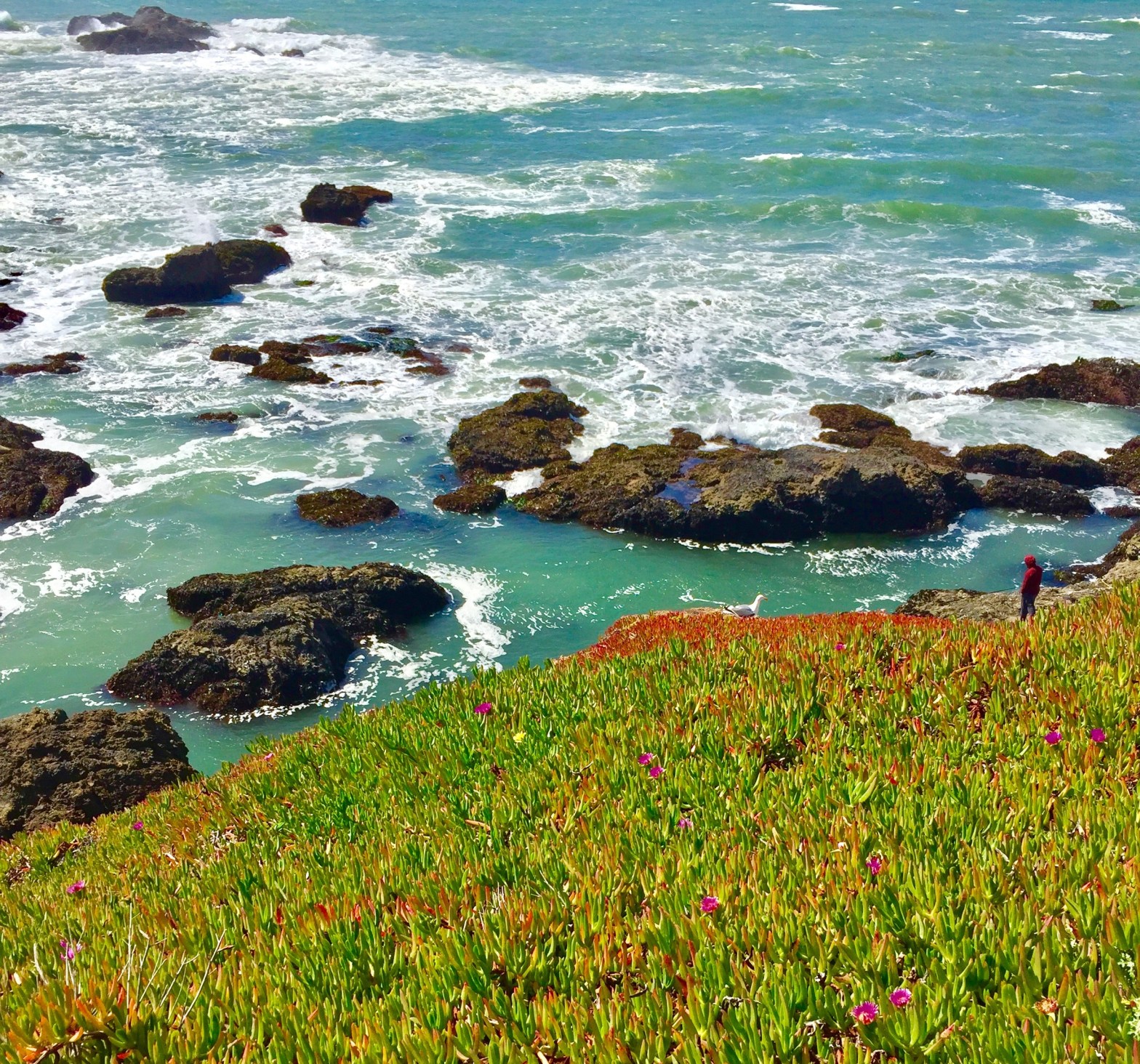
One of my first stops during my first week of living back in the bay area was to return to that lighthouse, a coming home of sorts.  I took a lot of photos.  When I returned home and began reviewing my photos to see what the best ones were, I discovered that one of them captured somethings I did not see at the time I took it.  I zoomed in and could not believe it.  There was a sea gull, cool.  But, the surprise, a person in a red sweatshirt, this time, with a ball cap on and the hood over it.  He or she, was peering out toward the sea!  They were not standing near the fence; they were down on the rocks far enough away where I did not even notice them when I was taking the photos. 

expand

Is it a worker, is it someone who lives in the youth hostel, I do not know?  Is it the same person, do not know?  What I do know is there is a message for me in these experiences.  As with photography, opening the aperture farther and farther, you can start to see more of the landscape in front of you.  When there is darkness, your vision is limited but when the sun comes up, you can begin to see right?  Is that what is happening here for me?  The lighthouse is symbolic, got it, but now I have this stranger who at first appeared in my photo as out of focus, but interesting enough to hang on my wall in my home for the better part of two years?  Now, I return to that same place as it is drawing inspiration for me and take another photo without knowing I snapped it of another one in a red sweatshirt? 

I have a feeling this lighthouse is going to become a place of continued inspiration and I must continue to expand my knowledge of that stranger.  On my next visit, I will be showing my photos to see if anyone knows of them.  I now want to meet this person and discover their story.  I have no doubt that when I do, they will understand how something as odd as a stranger in a photo can bring such inspiration to a person and that just might change the trajectory of their entire life.  Anyone who stands in front of the mighty ocean with their back toward the noise of the world behind them has a story to tell.

My Old Wooden School Desk

By Renee Shay, Harvesting Thought

-explore

When I was a child, my parents had moved us children, seven of us, around a few times until we eventually settled into a small town.  We had lived in the country; we had lived in a small town and then back to the country.  Heck, we even lived in the basement of my parent’s restaurant during one of the transitions.   It was about six times before we settled into another small town and that is where I grew up.  I was even born in a town called Portage even though I never lived there, the ultimate poetic gift of irony.  So, I was no stranger to moving from an incredibly early age and the time I am recalling now was no different.

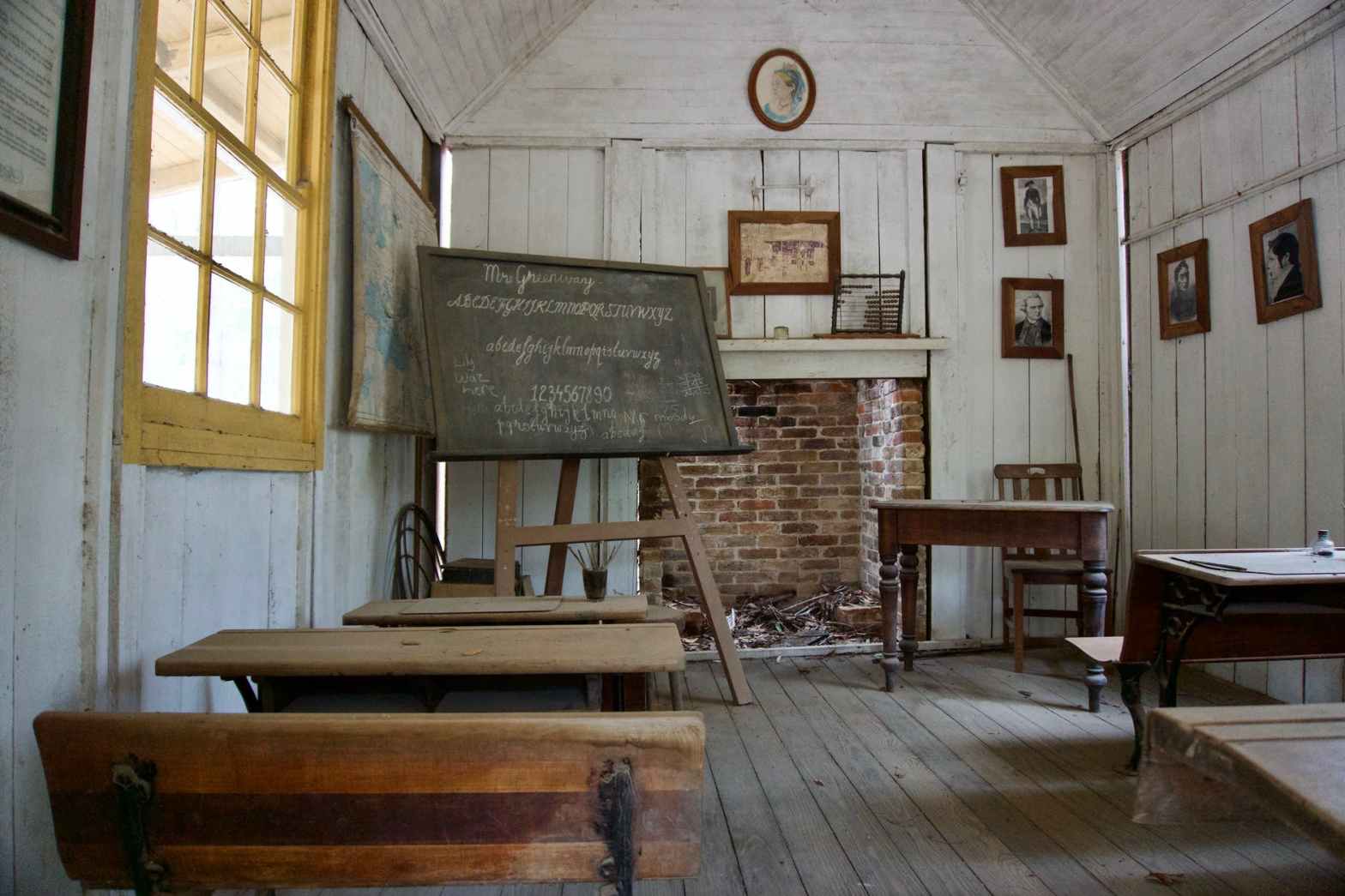
I remember the janitors packing my old wooden school desk up in second grade so they could send it to my new school.  Do you remember, the sturdy wooden topped desks with steel legs?  How they showed their wear and tear with craved initials in them from students who had used them before you.  The kind of desk you can lift the top up and store your school supplies in?  You remember, those desks.  Well, the new school I was heading to was in the same school district as my current one.  So, they wrapped up my desk, with my stuff inside, and took it away.  I suppose they wanted to deliver it ahead of my last days there so that it would be at my new school when I started on my first day.  I suppose, so I had somewhere to sit.  I remember feeling excitement for something new as I watched my desk leave the old classroom that day. 

challenge

On the other side of that experience, about six miles down the road, was my first day in my new school, my new classroom.  I remember the very moment the school aid walked me toward the wooden door. She opened the door and all eyes turned toward us standing in its threshold.  I stood there with her in the entrance and began to size up the room as I walked into it.  My excitement for something new had turned to a feeling of dread in that moment.  My new teacher introduced herself to me and me to the class.  She pointed me to my desk.  As I walked toward it a sense of calm began to fall upon me, not completely, but enough.  I could not have been happier to see my old friend.  It was not one of the other kids that I had recognized as I walked through the class; the old friend, it was my old wooden school desk. 

I do not remember if I ever used a wing compass tip to scratch my name into that old desk or not.  I will not ever know that that is okay.  What I do know is that the adults in my world then had no way of knowing how important that desk was to me.  They, I am sure, only looked at it as a transactional necessity to preserve their budget for the year.  What they did not know is how that desk had craved a memory into me.  Something familiar, something safe, had my stuff in it, a place for me to sit, a place for me to feel like I belonged.  Of course, the attachment to it was born out of that moment and would not have existed had it not been for the trauma of change.  I get that, but one never knows what one can become accustomed to until it is taken away or until it is returned.

expand

I cannot imagine what the children of this COVID19 Era have been experiencing when for a year now their worlds have been rocked by moving from an in-person environment to a virtual one, back and forth, depending on a surge.  Many have lost loved ones in their families on top of all that change.  I know how this pandemic has impacted me, as an adult.  But what about a child, during the critical years of forming their place in the world, their sense of security in the world, their friendships in the world, how is this impacting them?  How many children are going to be comforted by seeing an old friend when they too return to the classroom?  How many will not because everything old is now new?

Unfortunately, many children will be returning to new classrooms, with new kids, not just returning to the old.  Some kids will not have their old school desks to go back to like I had all those years ago.  They may now be surrounded by new desks spaced six feet apart.  They may be surrounded by sterile plexiglass.  They will be wearing masks that disguise facial features needed to be studied to know who is safe and who is to be avoided.  Their sizing up the room will be a greater challenge than I ever experienced in my lifetime. 

I do hope the school administrators, the teachers, and the custodians of our children, understand the gravity of what they are going through in this pandemic.  The return to the classroom cannot be about the business of educating children but about the beginning formations of turning our little humans into confident, secure adults.  It is also my hope that each of those children can find some comfort from a friend like I had found in mine, in my old wooden school desk.

Knock, Knock, Knock!

By Renee Shay, Harvesting Thought

explore

Knock, knock, knock!  Who is there, Justice, Justice who?  Justice once I would like see accountability (insert about any wrong you can think of).  This is where I awake and start my day, thinking about justice.  With a photo I took some years ago while in Washington D.C. and a knock, knock joke, here I go.  It was Shakespeare, I love that guy, where the origins of “knock, knock” began.  Full disclosure: I did not know the writings from him some 415 years ago would present such prefect inferences relating to our current affairs but then again, history repeats.  So, if not today, it will be something tomorrow, you do not need me to tell you that.  You, as the judge, can decide for yourself if you believe Shakespeare is still relevant today as I do. 

challenge

It is simple, history repeats.  I do not need to add one more word here as Shakespeare says it best in Act 2, Scene 3 of his play Macbeth.  In Macbeth’s castle, enter a Porter, knocking within.  Porter.  Here’s a knocking indeed!  If a man were porter of hell gate, he should have old turning the key.  (Knock.)  Knock, knock, knock!  Who’s there, i’ th’ name is Beelzebub?  Here’s a farmer, that hanged himself on th’ expectation of plenty (the farmer hoarded so he could later sell high, but when it looked as though there would be a crop surplus, he hanged himself).  Come in time!  Have napkins enow (enough) about you; here you’ll sweat for ‘t.  (Knock.)  Knock, knock!  Who’s there, in th’ other devil’s name?  Faith, here’s an equivocator (Jesuit who allegedly employed deceptive speech to further God’s ends), that could swear in both the scales against either scale, who committed treason enough for God’s sake, yet could not equivocate to heaven.  O, come in, equivocator.  (Knock.)  Knock, knock, knock!  Who’s there?  Faith, here’s an English tailor come hither for stealing out of a French hose, come in, tailor.  Here you may roast your goose.  (Knock.)  Knock, knock, never at quiet!  What are you?  But this place is too cold for hell.  I’ll devil-porter it no further.  I had thought to have let in some of all professions that go the primrose way to th’ everlasting bonfire.  (Knock.)  Anon, anon!  [Opens an entrance.]  I pray you, remember the porter.  New American Library: The Tragedy of Macbeth New York, New York (1998)

expand

Justice is something that comes after the fact so on one hand it is flawed.  It is seen as oftentimes useless unless it is intended to prevent something similar from occurring in the future.  Its power cannot bring back the dead and cannot prevent all alleged wrongs in the first place.  I believe it must always be remembered as inclusive for and from both sides, with no order, viewed as consequence and deterrence.  Even though it is the bedrock of well-functioning societies, people still die at the hands of other people, the ultimate injustice that should hold the highest price.  Humans kill humans, nothing more tragic than that.  If we do not want to hold those accountable to the highest betrayal a human can make, then why have justice at all?  Justice must hold accountable and deter those it governs, at the same time.  Justice should be applied to those who know that what they did was wrong equally to those who are incapable of recognizing the wrongs they have committed. Knock, knock, knock! Who is there?

Acceleration of Creativity: From Modernity into the Age of Self-Actualization

By Renee Shay, Harvesting Thought

explore

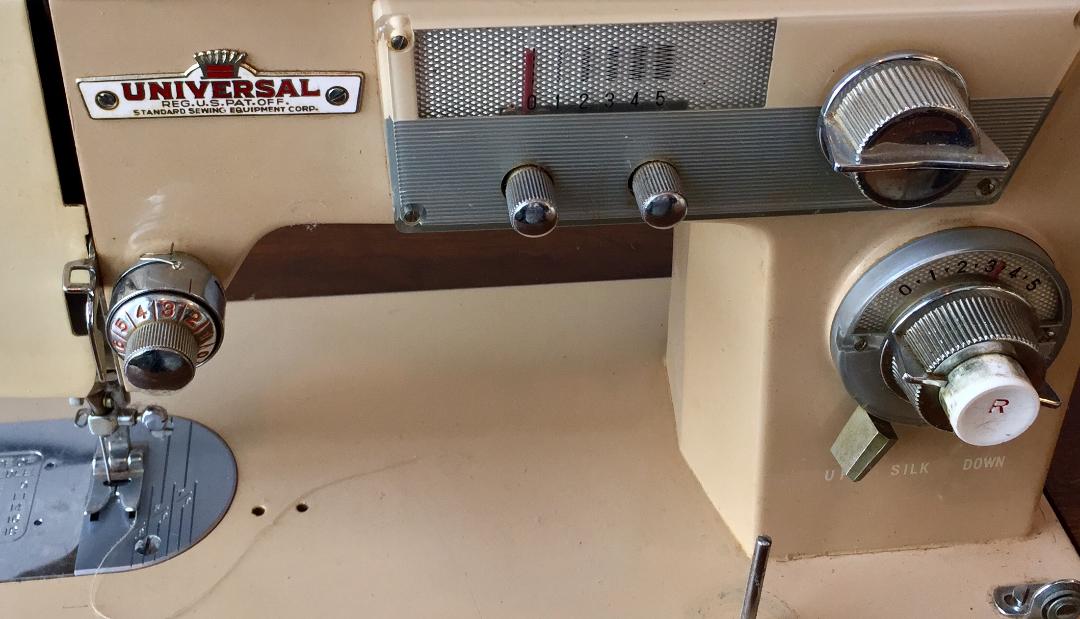
What drives a human beings need for creativity and wanting to share what they create with others?  Are they creating to fill a need for themselves, for others or for both?  Why do they do it when oftentimes creativity is something that may only be beautiful to the creator or not necessarily needed for one’s survival?  Why do some humans choose not to be creative?  Did your parent’s aspirations for you include painting, pottery, sewing and sculpting tools or were they hoping your endeavors would lead to something more utilitarian?

Do you have a passion that keeps you up at night or have you witnessed someone else cast aside everything else so that they could focus on a project of some kind?  Their need to create takes over and becomes more important than some basic needs like sleep, like food, like coffee?  Okay, I made the last point up about coffee, the constant companion.  I imagine many human beings in our modern time have experienced this phenomenon where their basic needs become less important because they are met and their need to be creative becomes paramount.  I believe that the need to be creative is accelerating though not always for the good.  This makes me wonder if we are at the precipice of modernity and starting to fall into a global age of self-actualization.  

My earliest childhood memory of the need to share something I created goes all the way back to around the age of four years old.  My parents had bought a restaurant and we, my parents and six siblings, were living in the basement.  One of my brothers and I had discovered the old men sitting at the bar loved the distraction of us kids coming upstairs so we started to become quite the hit.  At some point, my sister was the one who started it all, would send us back downstairs to do kid things like drawing.  When we would bring the drawings back upstairs to show them off to the patrons, they started giving us a nickel for each drawing we would bring to them.  Back and forth, we would run down, draw something quick then run back up the stairs.  When we got dimes for them that was even more exciting.  So it began, getting something of value other than praise, nickels, and dimes, for our creative toil.  From a early age we learned that creativity was a way of filling time, a distraction, a way to entertain others, getting attention and of getting something in return.

challenge

Every day we are bombarded with words and images that people are creatively combining to make into Internet social media posts.  People are creating messages to make us laugh, to make us think or to support a cause.  They are making posts to rally others who share similar views or to sew hatred for those they disagree with.  At its best, the creative information sharing is about every topic under the sun like health, the economy or about connections with family and friends.  At its worst, the Internet has become a virtual schoolyard playground on steroids for the world of bullies.  The creativity is impressive, good, and bad, and coming from people who would not normally be seen as creative.  Most everyone now has a cell phone; we now have a world of photographers.  Most everyone has an Inbox or Compose space at their fingertips to share thoughts; we now have a world of writers.  Instead of collecting nickels and dimes for childhood drawings; we now have a world collecting likes and emojis for creativity.

I remember my mother took me out for lunch one day while I was a young adult still trying to figure out my future.  At that time, I was exploring whether to continue pursuing a technical college associate degree that I had taken a hiatus from.  She told me, I remember this like it was yesterday, that pursuing higher education was important if I wanted more financial comfort from life and that it was okay with her if I did not want that.  I was perplexed, my father’s expectation was always higher education, and he would never have said that to me.  She said if I wanted to work in a small-town canning factory that would be just as noble as going back to school, especially knowing that the education I had been pursuing was not going to lead me into a career that I wanted anyway.  I know my father would never have told me that and it is why it was just me and her at lunch that day.

Full disclosure, my mom’s first job was at that canning factory that she was talking about and later in life one of her former bosses from there ended up helping her and my father by investing in their first business.  Her first job at a factory led her to become a successful businessperson with the means to raise seven children and help most all of them with their educational expenses, so her impression of factory work might have been a little skewed.  The irony that my father left his educational work for self-employment is not lost on me either. 

I was not one hundred percentage sure her idea of factory work was noble for me, and I figured that out quickly.  I ended up applying and working a total two days there.  A quality control green bean counter was not in my future.  I agree, noble for some, not for me.  Her real point for me on that day was just to be happy with whatever I choose to do and that she would support and love me just the same.  Higher education or factory work that does not require an education, those were the options.  Creative work was not something that could even be considered, it was aspirational and only for a few talented enough folks to be worthwhile.  Nowadays, it seems as if it is everywhere we look, and everyone is jumping in.

expand

Are we at a tipping point of modernity and moving into an era of self-actualization where our collective creativity is just getting started?  Have we hit the pinnacle of self-actualization and are now teetering at the tip of Maslow’s, “hierarchy of needs?” Abraham Maslow, American Psychologist, “Toward a Psychology of Being” (1962)

If we are on the top of it, where do we go from here, fall back to the bottom where basic needs become the driver of our lives again?  Are we witnessing the falling off from our better selves, our best human instincts and beginning to see the abyss of division, hatred toward others, in-fighting for control of what resources will be left on the planet with little to no compromise or concern for our fellow humans?

What I see today is so many people tapping into the creative process, again, both good and bad.  I do not have to go any farther than my own family to see the good.  There is contemporary music, dance studio lessons, the creating of essential oils or embellished clothing to better our lives.  Some of them have marketed their software expertise, some of us have sold books on Amazon or other items on eBay and some market their Airbnb online.  You name it, people, my family included, are harnessing all the technology at our fingertips to pursue creative interests. 

I also see the bad creativity from people I grew up with. The bigotry, the racism, the misogyny, the intolerance for difference, it is present. They are finding creative ways to make fun of and bully those that do not look, or act like them. Little do they know that all those people they make fun of are still their family, friends, coworkers, and neighbors. Often, they just do not know the people they hate are hiding in plain sight amongst themselves. We are all different, we all came from somewhere else and while you think you are better than someone, there will always be someone better than you. Comparing self to others is as old as humanity.

While not everyone is being creative to sell something, creating for good or for bad, they just do it for the need itself to create. It is undeniable though that we are all engaging in a new way of being. I highly doubt that Maslow could have predicted that we would globally arrive at the tier of self-actualization all at the same time because of the technology at our disposal.  This is the beginning of a move away from modernity and into the age of self-actualization, not the end.  That what we are experiencing today is an evolutionary shift and I am looking forward to witnessing and participating in the creativity yet to come.

Squaring the Circle of Democracy

By Renee Shay, Harvesting Thought

explore

Can you square something that its very existence is dependent on being diametrically opposed to its own self?  Seems like a contradiction in terms to take two shapes, a square and a circle, and try to figure out if you can find a way to reconcile them.  How do you do that?  It turns out that is an age-old question that has never been answered.  I did not know when I started thinking about how to square things that you cannot square a circle.  You may not be able to reconcile two shapes into the same shape as making a square into a circle, but I believe that does not mean that a shape cannot square itself even if it is a circle. 

In the article, “Squaring the Circle,” the authors acknowledge that even Aristotle found absurdity at the notion of attempting to square a circle, “the exponent of any science is not called upon to solve every kind of difficulty that may be raised, but only such as arise through false deductions from the principles of science.” Aristotle, Physics (384 BC-322 BC). This leads me to believe that certain things will never be reconciled when attempting to reconcile the wrong things.  Which makes sense in laymen’s terms.  JJ O’Connor and EF Robertson, Squaring the Circle (School of Mathematics and Statistics University of St. Andrews, Scotland, 1999)

challenge

It makes sense that not all problems are solvable, not everything fits into something else because all things should not be compared to each other.  If it is true that we cannot take two things that we perceive to be the same, like shapes, a square and a circle, and just render them into some harmonious state of being, then what?  How many things in life do we try to compare against each other to solve problems?  We try to fix one thing of the other to make it the same for us on the other side of whatever it is we are trying to correct. 

I can think of many things in life that we as human beings attempt to square but the one that is on mind these days are the two opposing political parties, Democrats and Republicans.  They are not the only two groups, just as a square and circle are not the only two geometric shapes, but they are the ones that come to mind for good reason.  They are the two most powerful groups that dominate the governance of our lives in the United States of America.  The saying that “you cannot put a square peg in a round hole” is one of the first lessons we learn as children.  Yet here we are as adults still grappling with that same problem when we look at our politics.  We somehow believe we will solve the differences between two groups when it is impossible to solve.  If we continue to try to square the ideology of Democrats with the ideology of Republicans what will be the result?  With the world watching, what has and what will be the result?

expand

In our political landscape we continuously have each side of the equation attempting to square the other, so each is seeing the other as the circle needing to be squared.  I want to suggest here that we need to stop focusing on the other, what shape they are against what shape we are and start focusing on ourselves.  If we focus on how we can shape ourselves within a party and start to see how we are able to change the shape we exist within from within, the possibilities for improving then now have a chance.  We need to recognize that it is okay to have different views of the world, different thoughts about governing, and that those views can exist in harmony separate from the other but occupy the same space.  

As Aristotle put it, you can square some things if they are based upon falsehoods but that is as far as you can square those things because like a square and a circle, they are not compatible elements to be made into one element.  Just as in science as in politics, two things may oppose each other but that does not mean that one or the other cannot be squared.  We do not have to change the other but the other might need to change something within them, as we need to change things within us to square the circle of Democracy. For Democracy to continue its success all parties need to oppose yet collaborate with each other when it is in the country’s best interest to do so. Most importantly, everyone needs to follow the same ground rules and that is what the Constitution is all about. We need to follow, protect, and defend it.

Selling Short

By Renee Shay, Harvesting Thought

explore

I recently put in for an opportunity to move across country which would be back to an area where I have lived in the past.  It would be for the same job I am doing now but in a different city than I live in now.  It would come with all sorts of newness like where to live, what to drive to work, who I would be working with?  What to wear?  Will they even select me?  Was my resume good enough?  What will my current boss think?  Will I have the confidence to overcome challenges of working in an unfamiliar environment with new people?  Can I do the job even though I have years of experience doing the same job already?  Self-doubt, uncertainty about whether it is the right decision for me while minimizing the potential of me getting it creeps into my mind.  I wonder how much of this selling short has prevented me from taking other actions in my life.

Where do I sell myself short?  Why do I sell myself short?  How do I develop confidence in the areas of my life that I have sold myself short?  These are the questions I ponder this morning while contemplating a career move.  As I walk into my living room, turn my lights on, waiting for my cup of coffee to brew, I look around and notice a photo that I have hanging on my wall.  There is nothing personal about it other than the memory of when I took it.  The reason I have it on the wall is that it is impersonal.  If you are going to sell your house, you should minimize and put away personal items so that prospective buyers can see themselves in your space not see you in it.  I have been staging my house for years in anticipation of selling, but just have not taken any significant step toward doing that until now.  This photo I had taken while out on a day trip up the coast from Scotts Valley to San Francisco, California while driving on Highway 1, it catches my eye this morning?  It anonymously draws introspection when you study it. 

Driving, taking photos, and exploring is something I love to do.  This photo was taken not on my first visit to the Hi Pigeon Point Lighthouse Hostel in Pescadero, California, but somewhere I have been to numerous times, a destination along the way.  The image is of a young man with his back toward me, standing on a rock while leaning his elbows on a fence, peering out toward the Pacific Ocean.  You can see the worn-out white paint on the picket fence around the area he leans on.  It is a very contemplative image and the most interesting part of it to me is the fact that it is unintentionally out of focus like stain-glass imagery.  Why this image is out of focus when the rest of my photos on that trip were not is baffling to me.  What is ironic about it catching my eye this very morning while I consider a move cross country, why I write about it, is the fact that it is from the same area of the country I am considering moving back to.  So, it just may be unconsciously not a coincidence at all.

challenge

Why do I feel the need to sell myself short?  Is it if I am let down, it is not that far down to go?  Is it because I am not all in anyway?  There are costs to change, am I fearful of them, whether monetary or personal?  Every day someone makes a change, packs up their home, their belongings, and heads to a new adventure.  Some take jobs in other cities and do not pack up; they live in both places, never fully committing to the new place.  I see that a lot, people taking promotions in other cities and leave their families behind.  This is not a new phenomenon.  Heck, I even did it, took a promotion in a different city before but never moved there.  I would spend the night in cheap hotel rooms when I was too tired from long workdays, split shifts or the weather was too bad to drive.  I even rented an apartment for a few months but mostly drove the distance back and forth for two years until my relationship at the time had ended and I had to decide on where to live next.  So, it is not as foreign to me as it might seem now that I am thinking about it.  The cost you could say is not always about money now is it, come to think about it.

Ideally, I do not want to leave the area I live in now.  It has lots of fresh waters, lakes, rivers, and woods where I can explore, fish, four-wheel and go camping.  It has the four distinct seasons that you tend to miss when you have lived in an area that is not much more than rainy and cold for a few months then hot.  But the other place, when I am there, I also feel at home.  I have family in both places, and it would be great to reconnect with the others I do not now get much time with.  I have more stuff to deal with if this happens, like a house, animals, toys, vehicles, unlike before when I just has a few personal belongings.  It was nothing to load up and head out but now is different, isn’t it?

I was recently sucked into playing the lottery.  I do not play it because I do not like spending the energy on dreaming of something that the odds of happening are so great, it will not happen.  But every now and then, when the excitement of a large jackpot is high, I jump in and play and say to myself, someone must win, why not me.  I did not win this last time even though I bought a couple tickets, and I went through the dreaming for a couple of days.  Alas, someone else won; good for them.  I then moved on with my day after hearing the news.

But what about the things in life that I do not have such big odds to overcome, the odds are more in my favor than I think?  It is riskier putting in for some of those things is it not?  I might win and then what?  The then what, oh my, more action will be needed, fear and panic set in.  It is scary sometimes to think about the “then what?”  How I spend time talking myself out of it and sometimes relieved that nothing changes in the end.  How many times has that happened?  I hold back, I do not give it my all, is that so I can lessen the sting of losing?  It that why I sell myself short? 

How often do I attempt to match my expectations with my own false perceptions of my worth based upon what I believe others may think of me?  Do I have this all backwards?  I reduce my self-confidence on a matter to match some preconceived notion of what others might think my talents, my capabilities are?  Meaning, I bring myself there first not the other way around?  Selling myself short before others get a chance to?  Talk about competitive.  I beat them to the punch at my own peril.  I win every time I do it but am I really winning when it is just me beating myself up?

expand

There is one area of my life I never held back.  I went into it with confidence and that area was sports.  I never sold myself short in that area of my life.  I stepped onto any court, any field and believed in myself.  Of course, there were nerves, but the confidence was evident, and the nerves only lasted through the first dripple of the ball or crack of the bat.  Why is that?  What is the difference for me between sports and other areas of my life like a career? 

Can I learn to approach my work, other interests in my life, like I approach sport competitions?  So often in a game I do not know what the final score will be, who will win or who will lose but I give it my all with confidence that I am talented and capable of playing the game just as much as anyone else.  I see others playing the game of life and think they have it all worked out ahead of time, but they do not either.  Others that I see doing the things like taking new jobs in new cities have the same stresses about where they are going to live, about how they are going to make the move, similar doubts, and fears as I have. 

I keep getting pulled back to the photo hanging on my wall with the young man leaning on the worn-out white picket fence that I mentioned earlier. Is this proof enough for me that he was not the first to stand upon that rock and will not be the last? I do not have a decision yet to make, but if there will come the time to have to make one about moving, do I believe, do I know, that I am not the first or the last to have to make such a decision?

I am hoping as I go through the next few chapters of my life that I do not continue to sell myself short.  If it is this opportunity that further develops into a new reality or something else, I do know that I am now opened to explore the possibilities of a new adventure. The door is now open. Just like the lottery, no matter the odds, I cannot win the game if I sit on the sidelines and decide not to play.  I need to stop selling short and believe that I have what it takes to win in every arena of my life.

Evolving, Is It Really That Hard in the 21st Century?

By Renee Shay, Harvesting Thought

explore

My parents never raised me to hate.  Think about that statement for a few seconds.  “My parents never raised me to hate.”  It sounds simply absurd to think about such a thing but here I am, surmising that some adult human beings had taught their offspring to hate while others had not.  When trying to understand the origins of hatred that some humans appear to harbor for others, I arrive at this question.  Evolving, is it really that hard in the 21st century? 

Having grown up in a ridiculously small town in western Wisconsin in the late 20th century, it was easy to make fun of others that were different than most of the town because most of the four hundred or so population appeared to all look, to talk and to act the same.  Sure, there were ethnic differences that were more noticeable to adults rather than children, like differences between the Norwegians, Scandinavians, Swedish, Irish, and Germans, but they were less than noticeable if not altogether invisible to a child’s eye. 

Diversity in my small town was about what European country your family had immigrated from not what color was your skin.  Many in the town were blood-related, so not too much of a stretch to suggest that they could easily mob together against someone who appeared different than themselves.  They were mirrors of themselves.  Many had grown up never pursuing education past high school if they made it through there at all.  Many never ventured outside the towns border far enough to experience any other view than another slightly bigger small town up the road.  The demographics have not changed much over the years, falling about 96.6% White, 0.9% Asian, 1.4% Native American, 1.1% other, with a population varying from 253 in 1910 to 556 in 2019 [Wikipedia data].

The jokes, the mimicking of other cultures for a good laugh, the role playing, all this seemed harmless at the time.  But was it?  With years of making fun of other races, of other ethnicities, of other countries, does it take a toll later in life if left unchecked?  Does it still manifest itself poorly in the ways of interacting with other adults now?  Does it inform and influence decisions about where a person chooses to live, what church they belong to, if any, form their political stances and even impact who someone decides to love?  Does it influence how people raise their own children? 

challenge

Do you call out prejudice, bias, racism, when you see it in your peers, in your child’s play?  Do you teach them that it is okay to call other people by stereotypical or racist names for a quick laugh?  Do you partake in the comradery of hatred over a few beers with your friends, “just having fun,” at someone else’s expense?  Do you make fun of those less fortunate, living here or in a third world country, who are trying to make the best of a dire situation?  Does that make you feel a part of something when you are bellied up to the bar in your small town on a Friday night?  Can you look back at your life and see how you have evolved or have not evolved in these areas and ask yourself why or why not?

I find it interesting that as an adult I have more diversity in my one city block of twenty urban households, 55% White, 20% Black, 15% Asian, 10% Hispanic, than there was and there is in the entire small town I grew up in.  Is that the difference, proximity to difference, which causes a population to evolve at a different pace than others?  Education, how much does that factor into the equation?  Work, if your vocation takes you to a bigger town to work in but not that much larger than where you live, does that hold you back? 

Based on my own experience, it is my belief that if you never get outside your bubble, you may never positively experience other races, other cultures.  I believe the toxic racism emanating from a small town is often more obvious than in a city.  It is more in the open because you do not have the “other” neighbors in ear shot.  It does exist in both rural and urban, it does exist in all cultures, with all races, though from my experience, I see it more prevalent from those I know from rural America than those I interact with in the urban areas.

It is a fact that rural America is still homogeneous to the descendants of white Europe, not much appears to change there.  The reason I lean toward the lack of proximity theory as part of the evolutionary clog of systemic racism is that I experienced it first-hand.  I did not routinely interact with races other than white people until I went to college at the University of Minnesota.  I did not get to know any other ethnic groups like Hispanics until I moved to California and worked in a restaurant with chefs and waiters who were from Mexico.  My thoughts and feelings toward others did not begin to evolve until I had these interactions with others different than those from my small town.  So, I do believe there is truth in the fact that personal access to others can propel a person to evolve more quickly than someone with limited access to those perceived to be different than them. 

I know this to be true because I was one of them from a small town who made the jokes, who looked upon others differently than me, who did not recognize the racial undertones in my choice of words or behaviors.  Even down to the childhood games we played, what side was the best to be on during a game and the counting sides for who is in and who is out, it was there.  Anyone not as white as we were becoming the “other” to be made fun of, to be ridiculed, to be excluded, to be looked down upon, to be considered less than to prop ourselves up. 

I can recognize with some of the people I grew up with in their social media interactions, right there on full display for the entire world to see, that they are still stuck in those views.  It is no longer kept in child’s play, it is no longer something that emerges every four years during political elections, the talks of immigration or socioeconomic issues, it is right there in the daylight of their posts, in their likes, in their comments, each day.  It is the white only privileged club; you are either in or you are out.  You will never know their privilege and safety in numbers.  You will never have the same freedoms to roam the lands of America if you are not one of them.  And that is what they fear most, losing that.

It is also worth noting that exceptions to this being a small-town phenomenon exist in both rural and urban America, especially if interactions between races and cultures are negative.  Of course, such events can inform people’s perceptions of others and be the crux of their racist views, but I would argue that is the exception rather than the rule.  Some of those living in urban areas today brought their racism with them from the small towns they grew up in.  Having just a short conversation with someone from rural America you can quickly discover that many of their racist views have not come from personal interactions with others.  One can conclude that experience did not cause their racism because they really have not had any.  It is usually more impersonal than that, formed from a distance based on what stories they were told, what lies they were fed.  Some parents were around to encourage and propagate the hatred while some parents were not around to stop it from developing.  Kids and adults now see or hear it 24/7 enforced on television, in the movies and on the World Wide Web.  No diversity day or discrimination law built to combat it is going to change someone’s mind. 

expand

The human inhabitants of planet Earth in this 21st century is so microscopically connected through technology and disease; you would think we would have evolved by now to a better acceptance of those different than ourselves.  We are all human and our survival may depend on our ability to get along as a species.  There appears to be no excuse yet here I am, still wondering why so much hate and why we have not all evolved? 

There is extraordinarily little we do not know about each other, we know most everything, very little yet to be discovered, so why can we not get along through understanding?  While there are still “uncontacted” ethnic groups in South America, Africa, India, and elsewhere, we still know they are there.  There has been contact throughout history and the only reason we have little contact now is to avoid bringing diseases to them that they have no defense for and the fact that they do not want us to contact them no doubt for similar reasons, for their own safety.  But some contact has brought them modern technology, why have they not adapted to it and changed?  Why do they still live in isolation with no modern technology to speak of except a sword blade or knife left behind by someone who has adapted to change?

If a life jacket floated up on a beach of some uncontacted tribe anywhere in the world, would that mean they would wear it to swim?  If a plane fell from the sky and landed in their jungle, would that mean they would then learn the mechanics of flight?  Technological accelerants that can fall from the sky into the laps of a band of hunter-gatherers does not equate to evolution.  If a plane fell from the sky and landed in my background I would surely know where it came from, I would understand what it was used for and might even understand some of its basic technology but that would not mean I would be able to build one myself.  Therefore, more knowledge of something does not bring any more evolution than less knowledge of something.  So, what else is it then that moves some forward while leaving some behind? 

There are examples everywhere in modern society of people from all races and ethnicities getting along.  There is no other place of diversity in the world today like America.  It is imperfect but who we are; what we are made of what we stand for, ideally the principles that have held our democracy together thus far.  If it is proven that we can get along in urban areas, why are there some of us not evolving into better humans from rural areas?  Is it because the advantages of hate still outweigh the advantages of letting it go or is it still something else? 

If you are the Sentinelese people living on an island in the Indian Ocean, what is your advantage to not allowing contact with others?  Is it about fear of the ones who appear different in skin tone, in the color of their eyes, in their mannerisms, in their dress?  Is it an attempt to protect the resources you have and are willing to kill for?  Is it fear of not understanding the other people’s language or fear of change?  Across the globe there are examples of those getting along and those that do not have the capacity to or desire to for some reasons like these, justified or not.  Many societies live near each other and do not understand each other’s language, but they get along.  It is not just an American issue to be solved, it is a human issue, it is a life issue, it is an animal issue, it can be a resource issue, but can we minimize and improve it?  Can we evolve from it into a more accepting and harmonious society?

Fear, what a powerful instinct, as it can be wise and irrational in the same moment.  Wise because it can initially protect us from something different yet irrational because most of fear is unjustified.  There is no threat, no one trying to take your land, take your home or cause you or your family harm.  Yet do you fear others?  Try to run through your house at night with all the lights out, your fear is heightened because the darkness obstructs your vision.  Yet in the daylight, with nothing that has changed in the house, you know where everything is in the dark as in the light, you lived in the same space for years, in the light you could run through it with no problem right?  The only difference is what you could see or not see, what information you had access to and what you did not.  So, information is helpful to reduce fear, but it is not the full answer.

We will continue to see some human beings stuck in a static evolutionary posture.  They are not going to adventure outside their bubble to experience things different than what they know, different than the safety of their home.  They will never realize that people in their small town are the same as people in a village halfway across the globe.  The others happen to be just as human as they are with the same wants, the same needs, and the same desires.  Unfortunately, most people’s fear prevents them from exploring new relationships with people who are different than them.  While technology is available so too is all the information about others at our fingertips, whether in books, online or in real life experiences.  We can learn everything about every race, every culture.  There are no secrets left, nothing left to be afraid of. 

My parents never raised me to hate those different than me and that does not mean I never hated something different or unknown.  Some parents have taught their children to hate but that does not mean their children and oftentimes now adults, must hate.  People can evolve when they separate themselves from their childhood, from their small-town community bubble and expand their minds toward acceptance of others that are different than what they know themselves to be.  Flipping the evolutionary switch that turns the lights on to new thought and action are hard, but it is not impossible.  I am living proof of that.  Let us not wait for the others to get disconnected from their hate, if you are witness to it, call it out and offer up a better way.  Let us start seeing all humans as our siblings with each one of us having something good and worthy to contribute to our human race.  For those that are incapable, may their hatred completely dissolve into their past as it is no longer funny, it is not acceptable, never should have been.  A mutation of thought will occur for them soon so that we all propel forward together and truly transform into better human beings or a new species altogether; that would be fine with me.